Multi-Country Safari: Is It Worth Crossing Borders in East Africa?
July 26, 2026
Where to see lions in Uganda: Best National Parks and Safari Tips.
Lions in Uganda don’t behave like lions anywhere else on the continent. In the Ishasha sector, they climb trees and rest along fig branches, the way leopards do elsewhere. Along the Nile at Murchison Falls, they stalk buffalo herds in sight of Africa’s most powerful waterfall. In Kidepo Valley, hard against the South Sudan border, they gather at a single dam in numbers that surprise even seasoned guides. Three parks, three different lion stories. The right one depends on your time, your budget, and how far off the beaten path you want to go.
This guide sets out where to see lions in Uganda, when to go, and what each park costs. It also covers who each destination suits best. There’s no marketing gloss here, just the kind of detail a guide would give you the night before you set off.
Ishasha: Where Uganda’s Lions Climb Trees
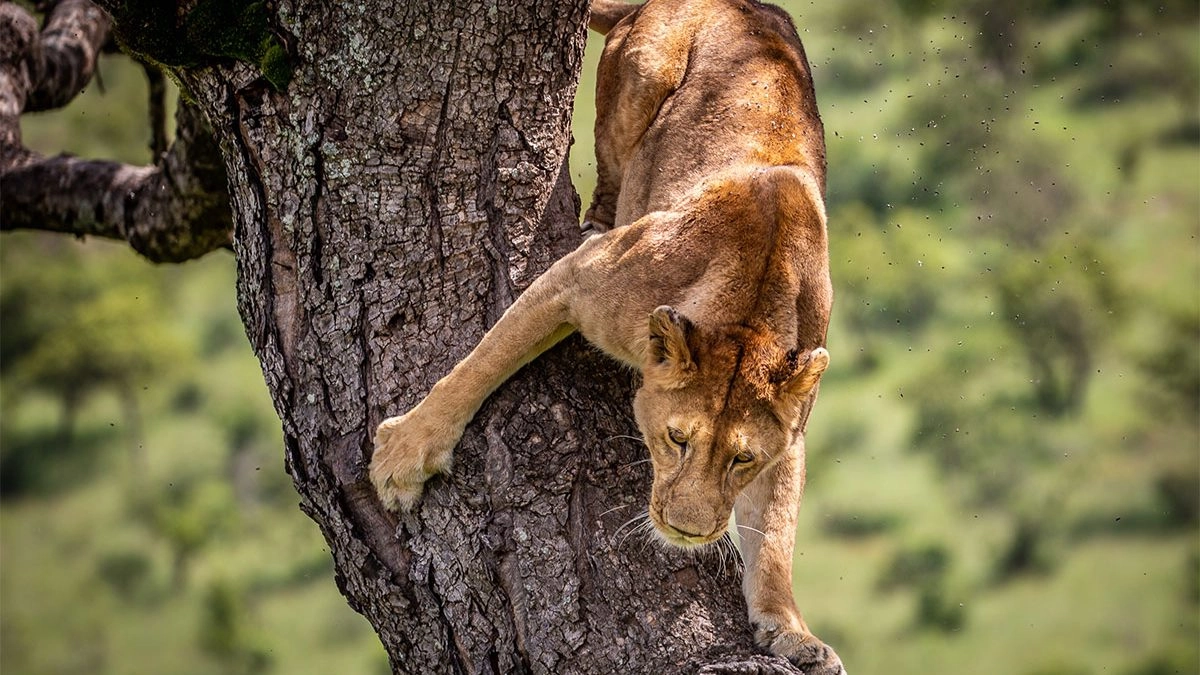
Tree climbing lions at Ishasha sector
Ishasha sits in the far south of Queen Elizabeth National Park, around five to six hours by road from Kampala. Most visitors come here for one reason: lions that climb trees. The behaviour is genuinely rare. Researchers have documented it consistently in only two places on the continent: Ishasha and Lake Manyara in Tanzania.
Ask a guide why, and two theories come up most often. Biting insects thicken on the ground during the heat of the day, and climbing gets the lions above them. Height also gives a clear view over tall grass toward grazing Uganda kob, their main prey here. Whatever the reason, the sight is striking. A lioness draped over a sycamore-fig branch, paw hanging loose, is something most safari veterans have never seen anywhere else in Africa.
No lion sighting is ever guaranteed, and Ishasha is no exception. Still, the odds shift with the season. The dry months, June to September and December to February, thin out the grass. They also keep the access roads passable. Both help. Midday, roughly 10am to 5pm, tends to work best, because that’s when ground heat pushes the lions upward.
Ishasha rewards patience over pace. Guides here track specific prides and know which trees they favour. A full day dedicated to this sector beats a rushed pass-through on the way to somewhere else. Budget lodges and tented camps sit just outside the park boundary. Ishasha lies more or less on the route south, so it slots naturally into an itinerary that also includes gorilla trekking in Bwindi.
This sector suits travellers chasing a genuine rarity, ones who don’t mind spending a full day, or two, waiting for the right sighting. It’s a poor match for anyone on a tight, single-park safari with no flexibility to sit out a quiet morning.
Murchison Falls: Uganda’s Classic Savanna Lions
Murchison Falls National Park offers a more conventional way to see lions in Uganda, and for most travellers, a more reliable one. Its lion population lives north of the Nile, spread across several prides. Guides estimate the number at somewhere around seventy individuals, concentrated in the open grassland of the Buligi Peninsula and along the delta near Lake Albert.
Two things make this population easier to find than Ishasha’s. The terrain is flat, open savanna rather than wooded riverine bush, so sightlines stretch for kilometres. Two well-worn circuits, the Buligi track and the Queen’s track, produce lion sightings on a large share of morning and evening drives. Occasional sightings even happen from the water, during the early boat trip into the Nile delta, where shoebill storks nest among the papyrus.
Murchison earns its reputation as Uganda’s flagship park by pairing lions with sheer volume. Elephant, giraffe, buffalo, and one of Africa’s densest hippo concentrations all sit within the same game-drive radius. The boat cruise to the base of the falls justifies the trip on its own. The trade-off is popularity. Murchison sits closer to Kampala than the other two parks, about four to five hours by road, or a short domestic flight into one of three airstrips. That makes it Uganda’s busiest savanna park. Vehicle numbers around the best sightings do climb during July, August, and the Christmas period.
This is the park for a first Uganda safari or a family trip on a limited timeline. It also works well for anyone pairing lions with chimpanzee trekking in nearby Budongo Forest. It suits fewer travellers who specifically want solitude or the tree-climbing spectacle, since Murchison offers neither.
Kidepo Valley: Uganda’s Wildest Lion Country
Kidepo Valley National Park sits in Uganda’s remote north-east, pressed against the borders of South Sudan and Kenya. It lies roughly 700 kilometres from Kampala. Estimates of its lion population vary by survey, with recent counts putting the figure somewhere above one hundred individuals. The precise number matters less than the setting. This is one of the best places to see lions in Uganda, precisely because it still feels wild rather than curated for tour buses.
The Narus Valley is fed by one of the only permanent water sources for miles. It concentrates wildlife the way any drought concentrates an ecosystem. Predators stake out the remaining waterholes, and prey has nowhere else to go. Guides here describe watching a full pride drink at Narus Dam while elephant and buffalo wait their turn nearby, often without another vehicle in sight.
That isolation is both the appeal and the catch. The road from Kampala takes around ten hours via Gulu. For most visitors on anything shorter than a two-week trip, a scheduled or chartered flight into Apoka is the practical option. Once there, the reward is game-viewing density that rivals East Africa’s best-known reserves, without the competing vehicles. A Kidepo add-on genuinely needs at least two full days to justify the travel required to reach it.
Kidepo suits safari veterans who’ve already covered Murchison or the Masai Mara and want somewhere that still feels undiscovered. It’s a weaker fit for first-time visitors on a short window who need guaranteed convenience over remoteness.
When to See Lions in Uganda: Matching Season to Sightings
Uganda’s two dry seasons, December to February and June to September, improve the odds of spotting lions in Uganda across all three parks. Thinner vegetation and shrinking water sources concentrate predators and prey alike. Short grass makes a resting pride easier to spot from a vehicle. None of the parks close during the wet months. Lions do turn up in the shoulder seasons too, often with fewer vehicles competing for the same sighting.
Costs move on a similar cycle. The Uganda Wildlife Authority reviews national park tariffs roughly every two years. It’s worth confirming current figures before booking, rather than trusting an older quote. As a general guide, non-resident park entry runs from around 40 to 50 US dollars per person for 24 hours, depending on the park’s category, with a separate game-drive fee on top. Where a dedicated lion-tracking activity is offered, it typically costs around 100 US dollars per person. That puts you alongside a researcher fitting or checking a pride’s radio collar, a different experience from a standard game drive and one worth booking ahead.
Choosing Between Uganda’s Three Lion Parks
None of Uganda’s lion destinations suits every traveller, and that’s worth saying plainly. Murchison Falls gives the best odds in the shortest time. It’s backed by the country’s broadest wildlife line-up and the easiest access from Kampala, at the cost of sharing the sighting with other vehicles during peak months. Ishasha offers something genuinely rare in its tree-climbing lions, but it asks for patience and a flexible schedule in return. Kidepo delivers the wildest, least-crowded lion viewing in the country, provided the traveller has the days and budget to reach its remote corner.
A first Uganda safari with five to seven days rarely goes wrong pairing Murchison Falls with either Ishasha or Kidepo. Which one depends on whether the priority is a specific spectacle or genuine remoteness. Travellers on a return visit, or those building a longer East African itinerary, gain the most from Kidepo. It demands the detour that first-timers tend to skip, and that detour is exactly the point.
Whichever park makes the shortlist, book the lion-tracking add-on and any flights well ahead of the dry-season peak. Both sell out faster than park entry itself. Terenga Safaris builds itineraries around exactly this kind of trade-off, matching the parks to how someone actually wants to see lions in Uganda, rather than defaulting to whichever route is easiest to sell. A short conversation about how many days are available, and what kind of sighting matters most, usually settles which park comes first.