
Uganda’s Best National Parks for a Short Weekend Trip
August 2, 2026
Best Time for Birdwatching in Uganda
August 3, 2026
Semuliki Valley Uganda: Why This Corner Feels Like Nowhere Else in the Country
Semuliki Valley Uganda doesn’t look, sound, or smell like the rest of the country. Cross the last Rwenzori foothills west of Fort Portal, and the savannah grass gives way to lowland rainforest. Oil palms crowd in, and the heat turns heavy and wet almost without warning. This is Semuliki National Park, Uganda’s only park built primarily on tropical lowland forest.
Geographically and biologically, the valley belongs to the Congo Basin more than to the East African plains most safari brochures picture. This piece covers what actually sets Semuliki Valley apart. It also covers what a visit costs and demands, and who should put it on their itinerary.
A Rainforest That Doesn’t Belong in East Africa
The Semuliki Valley sits in the Albertine Rift, wedged between the Rwenzori Mountains and the Semuliki River. That river forms the international border with the Democratic Republic of Congo. Geologists date the rift’s shaping to roughly 14 million years. The valley’s forest is an eastern extension of the Ituri Forest across that border, one of the oldest forests in Africa. Uganda Wildlife Authority gazetted the park in 1993 to protect it.
The result reads as Central African rather than East African. West African oil palms shade thatched huts along the park boundary. The Semuliki River, a miniature cousin of the Congo, carries water north to Lake Albert and eventually the Nile. Wildlife crossed with it: eight primate species live in the forest, including the rare De Brazza’s monkey. Chimpanzees live here too, though visitors hear them far more often than they see them.
The forest floor stays flat, dense and shaded. That’s a striking contrast to the jagged Rwenzori peaks visible from its edges. The flatness makes walking easier than in Uganda’s mountain parks, though heat and humidity ask more of visitors than a highland trek would. Anyone expecting classic savannah game drives should look elsewhere. Semuliki’s animals live under canopy, not on open plains, and sightings take patience.
Sempaya’s Hot Springs, the Valley’s Centrepiece
Semuliki Valley Uganda: Why This Corner Feels Like Nowhere Else in the Country
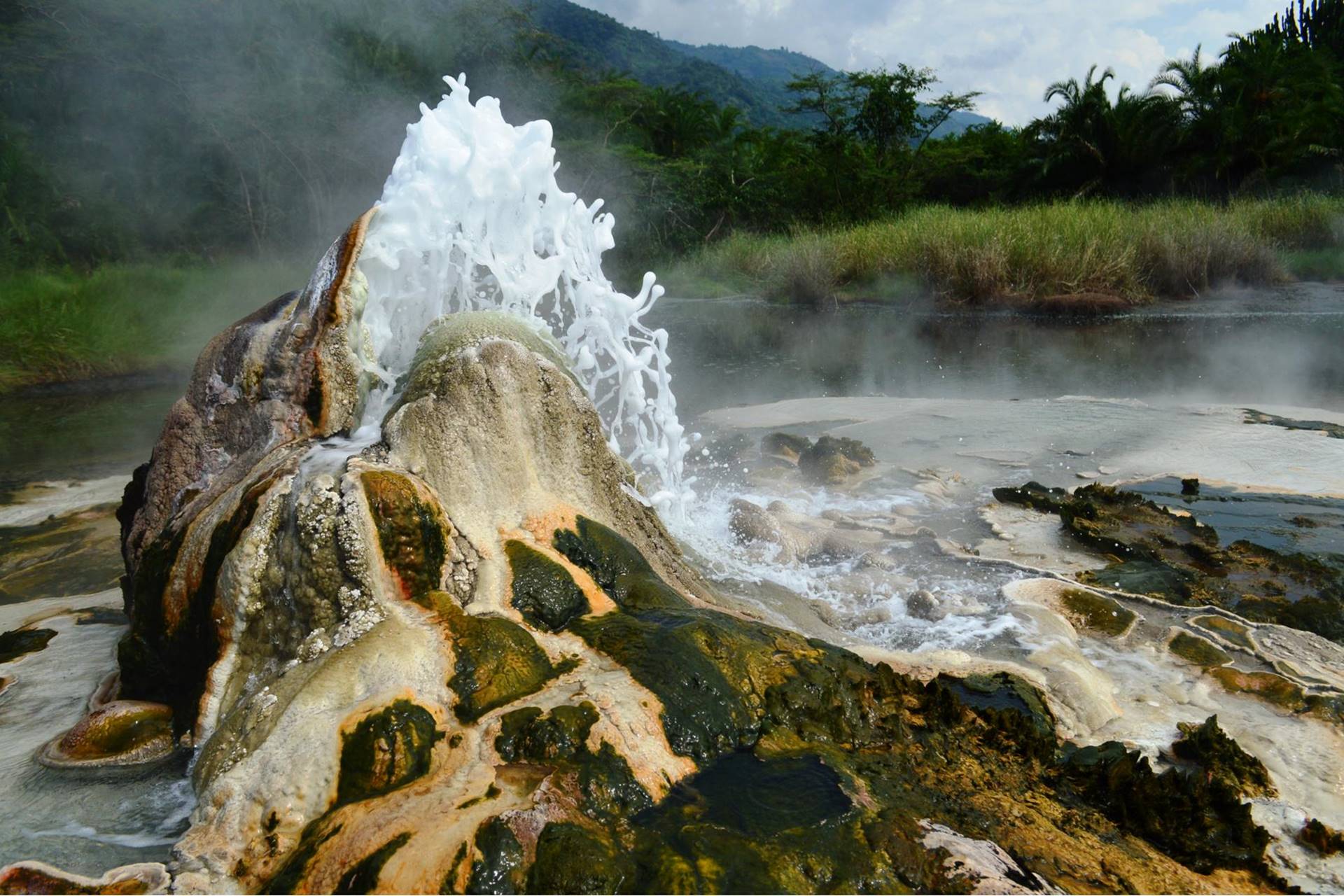
Most visits to the Semuliki Valley begin at Sempaya, roughly a two-hour drive from Fort Portal. Two hot springs sit within walking distance of each other. Bitende, known locally as the male spring, forms a wide bubbling pool about 12 metres across. Nyasimbi, the female spring, boils above 100°C and spits water more than two metres into the air. Local communities once used both to cook.
Guides still demonstrate that today. Visitors can boil eggs or plantains in the water on the short Sempaya nature trail. It has become one of the park’s signature moments. The springs sit at the edge of the Ituri forest extension, and the walk there doubles as an introduction to Semuliki’s birdlife. For visitors travelling with young children or limited mobility, the trail stays short and largely flat.
Longer options exist for travellers with more time. The Kirumia trail runs roughly 13 kilometres and takes about eight hours round trip, tracking deep into primary forest. The Red Monkey Trail, around 11 kilometres, follows the Semuliki River. It gives the best chance of spotting De Brazza’s monkeys. Neither trail is technically difficult, but both demand fitness and a full day.
Birds Found Nowhere Else in East Africa
Birders rate the Semuliki Valley among Uganda’s best forest birding, and the numbers explain why. Researchers have recorded roughly 440 bird species in the park. That’s close to half of everything ever logged across the border in Congo, because the forest is a direct extension of the Ituri. Around 130 of those species belong to the Guinea-Congo forest biome. They turn up nowhere else in East Africa.
The white-crested hornbill, the piping hornbill and the red-billed dwarf hornbill all favour the forest around Sempaya. Ross’s turaco and the great blue turaco add colour to the canopy. The elusive Nkulengu rail calls from the forest floor at dawn and dusk. Serious listers travel to Semuliki specifically for the Congo serpent eagle and the lyre-tailed honeyguide. Neither shows up reliably anywhere else in the country.
This specialism cuts both ways. Casual visitors hoping for the big-game energy of Queen Elizabeth or Murchison Falls will find Semuliki quieter and less immediately dramatic. But for anyone who already carries binoculars on safari, the valley rewards effort other parks can’t match.
A Valley of Four Cultures
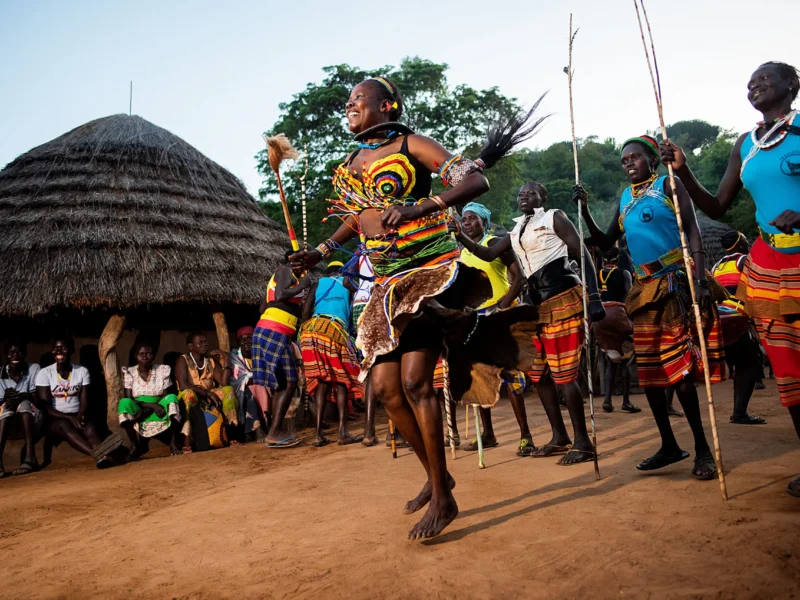
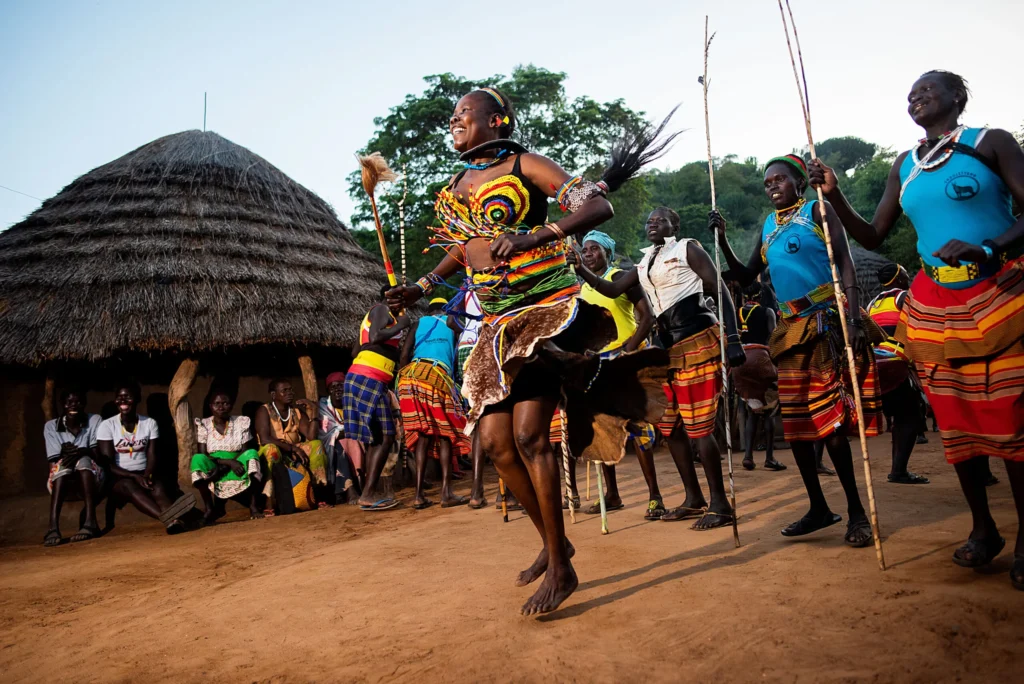
The Semuliki Valley is home to four distinct communities, each shaped by a different relationship with the land. The Bwamba farm the base of the Rwenzori foothills. The Bakonzo cultivate the mountain slopes above them. The Batuku keep cattle on the open plains, and the Batwa, traditionally hunter-gatherers, live along the forest’s edge.
The Batwa trace their origins to the Ituri Forest itself. Many were resettled outside the park boundary when it was gazetted in 1993. Some now work with Uganda Wildlife Authority to share that history through guided walks, dance and storytelling. Tourism has partly replaced the forest access their community lost. It’s worth treating these visits as a paid cultural exchange rather than a spectacle, and the difference shows in how guides and hosts are treated.
Cultural encounters like these add real depth to a Semuliki itinerary. They work best booked in advance through a park-registered guide, rather than arranged informally at the gate.
Getting There, Staying There, What It Costs
The Semuliki Valley sits roughly 360 kilometres from Kampala by the shorter route through Fort Portal. That’s a drive of six to seven hours, depending on road conditions. Charter flights land closer, at an airstrip near Semliki Safari Lodge served from Entebbe or Kajjansi, cutting travel time to under an hour in the air.
Uganda Wildlife Authority’s current tariff, in effect through June 2026, places Semuliki alongside Rwenzori Mountains and Mount Elgon National Parks in the same fee category. Foreign non-residents pay USD 35 per day. Foreign residents pay USD 25, and East African citizens pay UGX 150,000. Children pay a reduced rate. These figures change on UWA’s own schedule, so confirm the current tariff before booking rather than relying on any published number, including this one.
Accommodation runs from UWA-managed bandas and campsites near the Sempaya gate, simple and self-catered, up to Semliki Safari Lodge on the edge of the neighbouring wildlife reserve. The lodge offers full board and views toward Congo’s Blue Mountains. June to October and December to March bring the driest, easiest walking conditions. The rest of the year trades some comfort for quieter trails and lusher forest.
Who the Semuliki Valley Suits
The Semuliki Valley suits birders, hikers and travellers who already have a Uganda trip built around Bwindi, Kibale or Queen Elizabeth. It works best as one genuinely different day added to a longer trip. It rewards patience and a willingness to walk rather than drive for wildlife.
It suits less well the traveller on a first, short Uganda trip trying to cover gorillas, chimpanzees and classic game drives in a week. Semuliki’s distance from those circuits makes it a detour, not a stop along the way. Families with very young children may also find the humidity and longer trails harder going than a game drive.
The Detour Worth Deciding On
The honest case for the Semuliki Valley is narrower than most safari marketing admits. That’s exactly what makes it worth naming clearly. This is a stop for travellers who want Central Africa’s forest character without leaving Uganda, not a universal add-on for every itinerary. Terenga Safaris builds the valley into trips as a two-to-three-day extension from Fort Portal or Kibale, timed to the dry season and paired with a night at Semliki Safari Lodge. If the hot springs, the birdlife or the Batwa history sound like your kind of detour, that’s the conversation worth starting before the rest of the itinerary gets locked in.