
How Tourism Benefits Local Communities in Uganda.
July 27, 2026
Gorilla Trekking Difficulty
July 27, 2026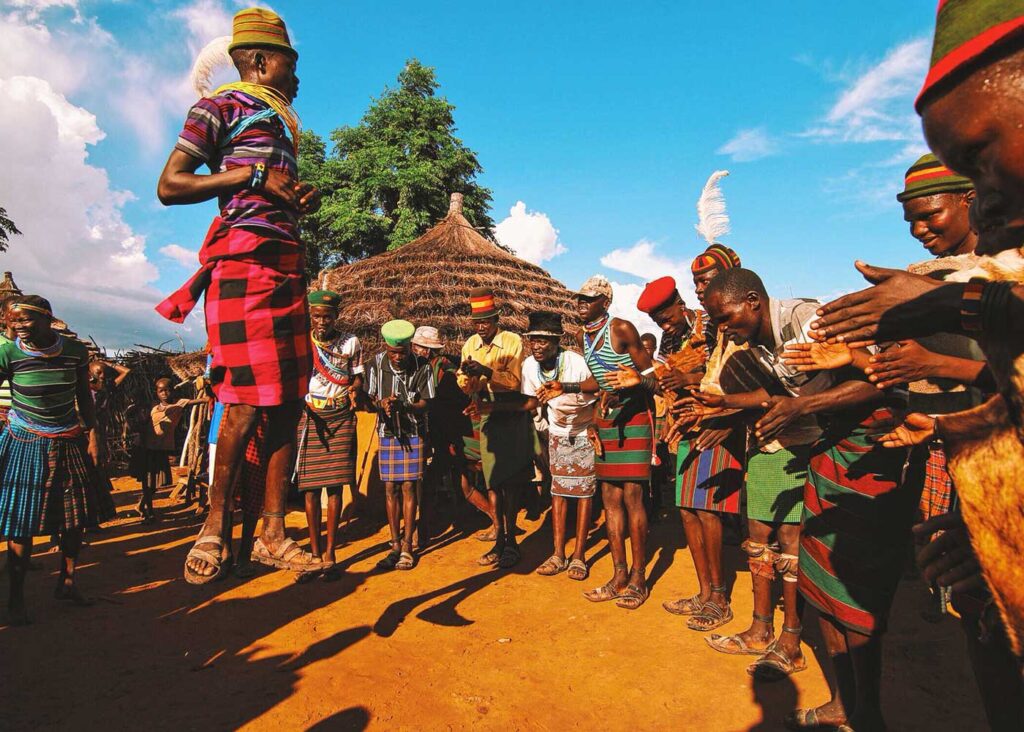
Community Tourism in Uganda
At the Ride 4 a Woman centre in Buhoma, a group of women sit at treadle sewing machines. They stitch quilts from offcuts of local cotton, a short walk from the Bwindi gorilla trekking trailhead. A visitor waiting to trek gorillas the next morning can spend an afternoon here instead. They might learn to weave a basket, or help grind cassava for the evening meal. This is community tourism in Uganda in its most visible form: a direct, traceable link between what a traveller spends and what a household earns.
It’s worth understanding this before you book. Not every tourist dollar in Uganda reaches a community the same way. Knowing the difference changes where you choose to stay, eat, and spend.
Uganda’s tourism sector earned an estimated US$1.62 billion in 2025. It directly supported more than 876,000 jobs, close to 7.5% of all national employment. Young people under 35 make up 63% of that workforce. Behind those national figures sits a patchwork of formal revenue-sharing law, guiding jobs, women’s cooperatives, and craft markets. Each reaches communities differently, and with different levels of reliability. This piece walks through how community tourism in Uganda actually functions, what it delivers, and where it still falls short.
The Legal Mechanism: Revenue Sharing Around the Parks
Community tourism in Uganda has a legal backbone. Under the Uganda Wildlife Act, the Uganda Wildlife Authority must return 20% of park entrance fees to the local governments bordering each national park. At Bwindi and Mgahinga, gorilla trekking adds a further US$10 from every permit sold, on top of that 20% share.
The money moves through district councils down to parish level as conditional grants. It can only fund specific categories: reducing human-wildlife conflict, or improving household livelihoods. In the 2024/25 financial year, UWA distributed over UGX 10.2 billion in revenue-sharing funds. The money reached districts around Murchison Falls, Queen Elizabeth, Kibale, Mgahinga, and Bwindi. Buliisa district, on the edge of Murchison Falls, used part of its share to help build the Bugana Health Centre III.
A single gorilla permit currently costs US$800 for foreign non-residents. UWA introduced a discounted rate of US$600 for the low-season months of April, May, and November. Permit prices and revenue-sharing figures change often. Confirm current rates directly with UWA or your operator before booking.
The system has real limits, though. Investigative reporting has documented gorilla permit fraud undermining trust in the scheme. Researchers studying revenue sharing around Kibale found something similar: fund distribution has historically suffered from weak accounting and slow disbursement. A traveller’s fee genuinely reaches a district government account. Whether it reaches the specific village nearest the park, and how quickly, depends on local administration that UWA doesn’t fully control.
Jobs the Safari Industry Creates Directly
Revenue sharing is only one channel behind community tourism in Uganda. Most of the sector’s economic benefit comes through ordinary employment instead: guides, drivers, lodge staff, porters, and the farmers who supply kitchen produce to camps.
Picture a farmer near Kasese who now sells vegetables weekly to a lodge kitchen at Queen Elizabeth National Park. That’s steadier income than relying solely on unpredictable market days in town. Or picture a young man from Rushaga, trained as a UWA ranger guide. He earns a stable wage that didn’t exist in his village a generation ago. These jobs rarely appear in headline statistics. But they explain why tourism now provides close to 7.5% of Uganda’s total employment, more than double its direct GDP share.
This channel works well because it’s immediate. It doesn’t depend on government disbursement schedules. A lodge that hires locally puts money into a household the same month it opens. The limitation is geography. These jobs concentrate near established circuits: Bwindi, Queen Elizabeth, Murchison Falls, and Kibale. Communities near quieter parks such as Kidepo Valley or Semuliki see far less of this employment effect, however spectacular the wildlife there.
Community-Run Enterprises You Can Actually Visit
Beyond fees and formal jobs, Uganda has a genuine tier of community-owned tourism businesses. These keep the entire visitor spend local, rather than passing through a district budget first.
Ride 4 a Woman is a good example. Evelyn Habasa founded it in 2009 near Bwindi. It now trains around 300 women from eleven surrounding villages in tailoring, basket weaving, and hospitality. Bicycle tours, craft sales, and guesthouse stays fund almost all of it.
The Batwa Trail is another. It runs with the Batwa people, displaced when Bwindi became a national park. The trail gives visitors a guided forest walk led by Batwa elders. They explain how their community once lived and foraged in this forest. It’s one of the few community tourism experiences in Uganda where the guides are also the traditional owners of the land they’re describing. That distinction is worth noticing.
Similar cooperatives operate around Lake Bunyonyi, Kibale, and the Rwenzori foothills. They typically offer village walks, coffee-to-cup demonstrations, or homestays, priced well below international lodge rates. A half-day sewing lesson at Ride 4 a Woman costs around UGX 30,000. That’s a fraction of a gorilla permit, and the entire fee stays with the women running the session.
The trade-off is comfort. These enterprises rarely match the polish of a commercial lodge, and quality can vary by who happens to be hosting that day. Travellers wanting a five-star finish alongside genuine community contact usually pair one or two community visits with more conventional accommodation. Few build an entire itinerary around community tourism alone.
Where the Model Still Falls Short
Balance matters here, so it’s worth naming the gaps in community tourism in Uganda directly. Revenue-sharing funds sometimes arrive months after the financial year they’re meant to cover. That frustrates communities budgeting around a specific clinic or borehole project. Corruption and fraud around gorilla permit sales have also surfaced in investigative reporting. Each case chips away at trust in a scheme designed to build it.
Gains cluster geographically too. Villages next to Bwindi see far more benefit than communities near quieter parks, even where conservation costs are similar. Fewer visitors simply means less money moving through the system.
There’s a seasonal reality as well. Peak gorilla trekking months bring crowding to Buhoma and Ruhija. Small community projects, built for modest visitor numbers, can strain under that load. The best trekking conditions, from June to September and December to February, are also when demand for community experiences peaks. Prices rise for both at the same time.
How to Make Sure Your Own Trip Gives Back
None of this requires a specialist “impact trip.” Small, deliberate choices shift where your money lands. Book at least one night with a locally owned lodge or community campsite, rather than an international chain property. Add a half-day community walk, craft session, or the Batwa Trail alongside your main wildlife activity. Treat it as part of the itinerary, not an optional extra.
Buy crafts directly from the makers at Ride 4 a Woman or similar cooperatives, rather than from curio shops in Kampala. Tip guides and porters in cash, rather than assuming it’s bundled into your package price. None of these steps cost much more than a conventional itinerary. They simply redirect spending that would otherwise leave the district entirely.
At Terenga Safaris, we build community stops into itineraries as standard, not as an upgrade. The difference in traveller experience is usually as noticeable as the difference in local impact. If you’re planning a Uganda trip and want an itinerary that balances wildlife time with genuine community tourism, that’s worth discussing before you book flights, not after.