Masai Mara vs Serengeti – Which Park Should You Choose?
July 7, 2026
Uganda vs Kenya Safari
July 8, 2026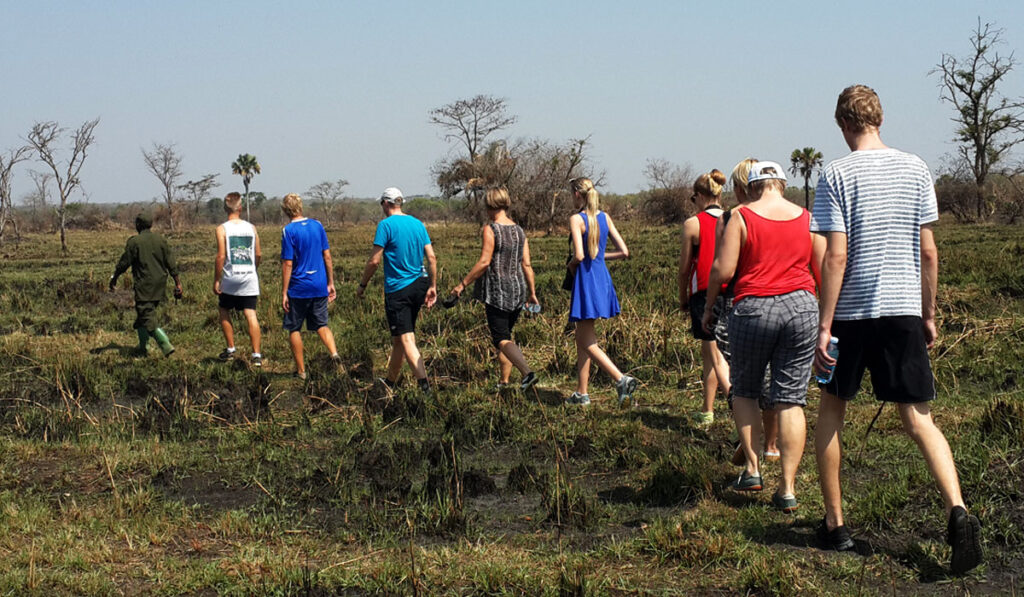
Why Group Safaris Are the Smart Choice for Combined Safaris
There is a particular moment that seasoned East Africa travellers describe in similar terms, regardless of where they were when it happened. You are sitting on the roof hatch of a Land Cruiser somewhere between Kibale National Park and Queen Elizabeth, forest giving way to open savannah, when someone in your group quietly points out a troop of olive baboons crossing the road ahead. Nobody arranged it. Nobody paid extra. It simply happened because you were moving through the landscape at the right pace, with the right people watching. This is the understated logic behind group safaris, and it is why travellers who choose this format for combined itineraries across Uganda and East Africa often find themselves planning a return trip before the first one has even ended.
Group safaris are not the obvious choice for every traveller, and this article will not pretend otherwise. But for anyone combining multiple parks, habitats, and wildlife experiences within a single journey, they offer advantages that are difficult to replicate privately, and at a cost that makes the mathematics considerably more comfortable.
What Group Safaris Actually Look Like in East Africa
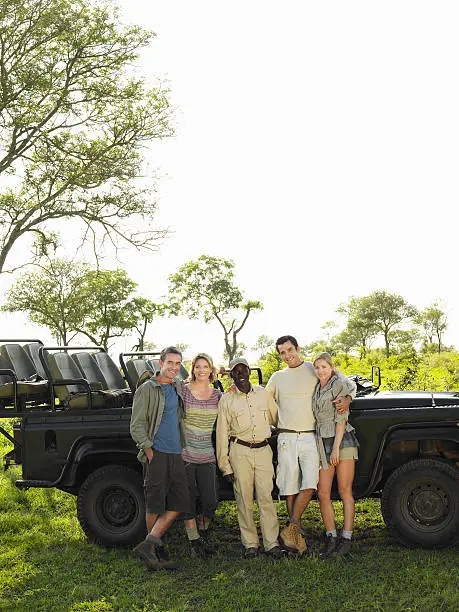
The phrase group safari carries a lot of assumptions, most of them wrong. Many travellers picture overcrowded minibuses and rigid schedules with no flexibility. In practice, group safaris across Uganda and East Africa typically move in small vehicles carrying six to eight passengers, led by a single experienced guide who doubles as naturalist, logistician, and occasional wildlife interpreter.
On a combined safari, the itinerary might link Kibale National Park for chimpanzee trekking, Queen Elizabeth National Park for tree-climbing lions and a Kazinga Channel boat cruise, and Bwindi Impenetrable Forest for mountain gorillas. Each of these environments demands a different kind of attention. Dense rainforest walking requires a slower pace and patient observation. Open savannah rewards broader scanning and patience at waterholes. A good group guide adjusts naturally between these modes, and a small, well-matched group tends to sharpen rather than blunt that attentiveness.
The key distinction worth understanding early is between a scheduled group departure, where you join other travellers on a pre-set date, and a private group, where you travel with friends or family but still benefit from shared vehicle costs and group permit structures. Both models work well for combined itineraries; they suit different budgets and travel styles.
The Financial Logic of Group Safaris on Combined Itineraries
A combined safari in Uganda involves permits, park fees, accommodation, transport, and guide costs across multiple destinations. Each category carries real weight. A gorilla trekking permit alone currently costs six hundred US dollars per person. Add a chimpanzee trekking permit, two or three park entrance fees, fuel for long drives across western Uganda, and comfortable lodge accommodation, and the total for a week-long itinerary climbs quickly.
Group safaris bring this arithmetic under control. Fuel costs for a Land Cruiser driving between Kibale and Bwindi are the same whether two people or six people are sitting inside it. Vehicle hire, tolls, and driver costs are fixed overheads that group travel distributes across more passengers. The per-person saving on transport costs alone can fund an additional night’s accommodation or a second trekking experience that a solo traveller would otherwise have to forego.
There is a related benefit that rarely appears in cost comparisons: the group permit structure for chimpanzee habituation experiences, certain community experiences, and some forest walks is designed around groups rather than individuals. A solo traveller may find themselves paying a higher effective rate, or waiting for a group to form, while a group traveller simply books and goes.
None of this means group safaris are cheap. A well-run, small-group safari across Uganda’s western circuit is a meaningful financial commitment. But for the quality of experience it delivers across multiple parks and ecosystems, the value comparison with an equivalent private itinerary is genuinely compelling.
Why the Group Dynamic Enhances Wildlife Sightings
It sounds counterintuitive. More people, you might assume, means more noise, more disruption, and fewer animals. In practice, across Uganda’s national parks and forests, the opposite is often true.
A shared vehicle means a shared pair of eyes. Six people scanning a forest edge, a distant treeline, or a riverbank simultaneously will spot more than one person watching alone. The person on the left notices the buffalo half-hidden in the reeds. The person on the right catches the martial eagle landing three hundred metres away. The guide connects these observations into a coherent picture of what the habitat is doing on that particular morning. This collective attention is one of the less-discussed but more meaningful advantages of group travel through wildlife areas.
In forest environments like Kibale or Bwindi, where visibility is limited and animals move quickly through dense undergrowth, the value of multiple observers is even more pronounced. During chimpanzee trekking, a group that stays quiet and coordinated, moving as a single unit under guide direction, will often produce better sightings than an anxious solo visitor trying to keep pace with a community ranging across several kilometres of canopy.
There are genuine limits here. Overcrowded vehicles, groups larger than the recommended maximum, or travellers who are unable to stay quiet at critical moments can disrupt encounters rather than enhance them. This is why group size matters. The difference between a group of six quiet, engaged wildlife watchers and a group of twelve varied travellers with different expectations is measurable, both in sighting quality and in how the animals themselves behave.
Local Knowledge Travels Better in a Group
One of the features of group safari travel that receives less attention than it deserves is the depth of local knowledge that flows more naturally in a group context. A good East African guide reads landscapes, translates behaviour, and narrates the ecological connections between species in real time. This is the kind of knowledge that takes years to build and cannot be replicated by a self-drive itinerary or a guidebook.
In a group setting, that knowledge gets distributed, questioned, and deepened through conversation. When a guide explains why a particular fig tree along the Kibale forest edge is drawing so many species at once, the questions that follow from a curious group invariably produce better answers than a guide speaking to themselves. What does the fruiting cycle mean for chimpanzee ranging? How do mangabeys and red-tailed monkeys compete for the same resource? Why does the presence of a crowned eagle overhead change the behaviour of every monkey in the canopy almost instantaneously? These are the conversations that turn a safari from a sightseeing exercise into something more lasting.
Solo or small private groups certainly have access to this expertise too. But there is something about the dynamic of a well-matched small group that tends to draw it out. Guides respond to engaged audiences. The more questions asked, the richer the narrative becomes.
Group Safaris and the Rhythm of Combined Itineraries
Combined safaris across Uganda or East Africa involve long drives. The journey from Kibale National Park to Bwindi Impenetrable Forest takes the better part of a day, winding through the tea estates above Kasese and climbing toward the Albertine Rift escarpment. The road between Murchison Falls and Kidepo Valley National Park in Uganda’s far northeast is longer still, passing through remarkable savannah and semi-arid landscape before arriving at one of the continent’s most remote parks.
These drives are not lost time. They are part of the experience. And they are considerably more rewarding in a group. Shared observation of roadside wildlife, conversations about what has been seen and what is still ahead, impromptu birding stops when something interesting appears on a wire, the accumulated texture of a journey through multiple ecosystems, all of this is amplified by the presence of good travelling companions.
The practical logistics of combined itineraries also benefit from group structure. A group safari built around a defined itinerary removes a considerable planning burden from the individual traveller. Permits are organised collectively. Accommodation is confirmed in advance. Meal stops are arranged rather than improvised. The small decisions that accumulate into large stress on a complex multi-park trip are managed by people who have made the same journey many times before.
This is not to say flexibility disappears. The best group safaris build margin into their schedules, arriving at destinations with enough time to respond to what the landscape is offering rather than simply ticking boxes. That flexibility is most useful, however, when the structural logistics are already handled.
Honest Considerations: When Group Safaris Are Not the Right Choice
A combined group safari through East Africa is not the right choice for every traveller, and pretending otherwise would do a disservice to the format.
Travellers with very specific photographic requirements, for instance, may find group schedules too constraining. A wildlife photographer waiting for a particular quality of light on a forest floor may need a vehicle that stops and waits indefinitely. A group itinerary with lodges booked at specific times cannot always accommodate that patience. For serious photographers, a private vehicle with a guide who understands the brief is usually worth the additional cost.
Families with young children face particular considerations. Most chimpanzee trekking permits require participants to be at least twelve years old. Gorilla trekking sets the minimum at fifteen. These restrictions mean family itineraries often require creative structuring, combining primate experiences for adults with alternative activities for younger travellers. A private arrangement typically handles this more gracefully than a scheduled group departure designed for independent travellers.
Travellers with significant mobility constraints or specific health considerations also warrant individual planning. Forest terrain in Uganda is rarely flat or predictable. A group moving at the pace of its most capable members may not suit everyone. A private guide who understands your specific requirements from day one will always offer more tailored support.
If you are considering a group safari, be honest with yourself about your travel style. Do you prefer to move at your own pace? Are you comfortable sharing a vehicle for several days with strangers? Do you have strong preferences about where and when you eat, or how long you stay at a particular sighting? These are not trivial questions. The best group safari experiences happen when expectations are aligned from the start.
The Social Value of Shared Safari Experiences
There is a dimension to group travel that resists easy articulation but is genuinely worth acknowledging. Witnessing something extraordinary in the company of other people changes the experience of it. When a family of mountain gorillas emerges from Bwindi’s undergrowth and a silverback settles twenty metres away to examine the group with calm curiosity, the shared silence that falls across the trekkers in that moment is something that each person will carry independently, but remember collectively.
Solo travellers or small private groups have equally powerful encounters. But the thread of shared memory that group travel produces, the references, the inside observations, the photographs exchanged afterwards, adds a layer of meaning that lingers longer than the moment itself. Many travellers who book group safaris as solo participants leave with friendships built across the vehicle seats and forest trails of a week-long itinerary. This is a quiet benefit that the brochures rarely mention.
Planning a Combined Group Safari: What to Look For
Not all group safari operators approach combined itineraries with equal care. When evaluating options, the details matter more than the headline price.
Group size is the most important variable. A vehicle carrying more than six to eight passengers for a multi-day combined itinerary starts to compromise the quality of both wildlife viewing and the guide relationship. If the group size is not clearly stated, ask for it before booking.
Guide experience across multiple ecosystems matters on a combined trip in a way it does not on a single-destination safari. A guide excellent in savannah environments but unfamiliar with forest primates will deliver an uneven experience across a Kibale-Bwindi itinerary. Ask specifically about the guide’s background across the parks included in your itinerary.
Permit handling is worth confirming in detail. On a combined Uganda itinerary, multiple permit categories must be coordinated around specific dates and park regulations. How the operator manages this, whether they hold allocations or book on demand, will affect your certainty of securing the experiences you have planned for.
Finally, read the itinerary itself carefully. A combined safari that packs too many destinations into too few days leaves travellers exhausted and rushing. The best itineraries build in recovery time, unhurried mornings, and margin for the unexpected. Wildlife does not operate on schedules, and the most memorable encounters often happen in the unplanned spaces.
A Practical Format for a Complex Journey
Combined safaris across Uganda and East Africa are among the most logistically involved journeys a traveller can undertake. They span vastly different ecosystems, require permits booked months in advance, and involve long drives across genuinely remote terrain. Getting the format right matters.
Group safaris, when structured well around small numbers and experienced guides, offer a combination of cost efficiency, collective wildlife observation, and shared local knowledge that is difficult to replicate in other formats. They are not perfect for every traveller or every trip, but for those planning a multi-park East African itinerary with a realistic budget and an appetite for the social texture of shared travel, they are often the most sensible and rewarding choice.
Terenga Safaris designs group and private itineraries across Uganda and East Africa with the kind of local expertise that comes from years of navigating these landscapes. If you are working out how to combine the forests of western Uganda with its savannah parks, gorilla trekking with wildlife game drives, or any other combination of East Africa’s remarkable destinations, a conversation with the right people is usually the best starting point.