Masai Mara vs Uganda’s Savannah Parks.
August 8, 2026
The Best Way to Travel Between East African Countries
August 10, 2026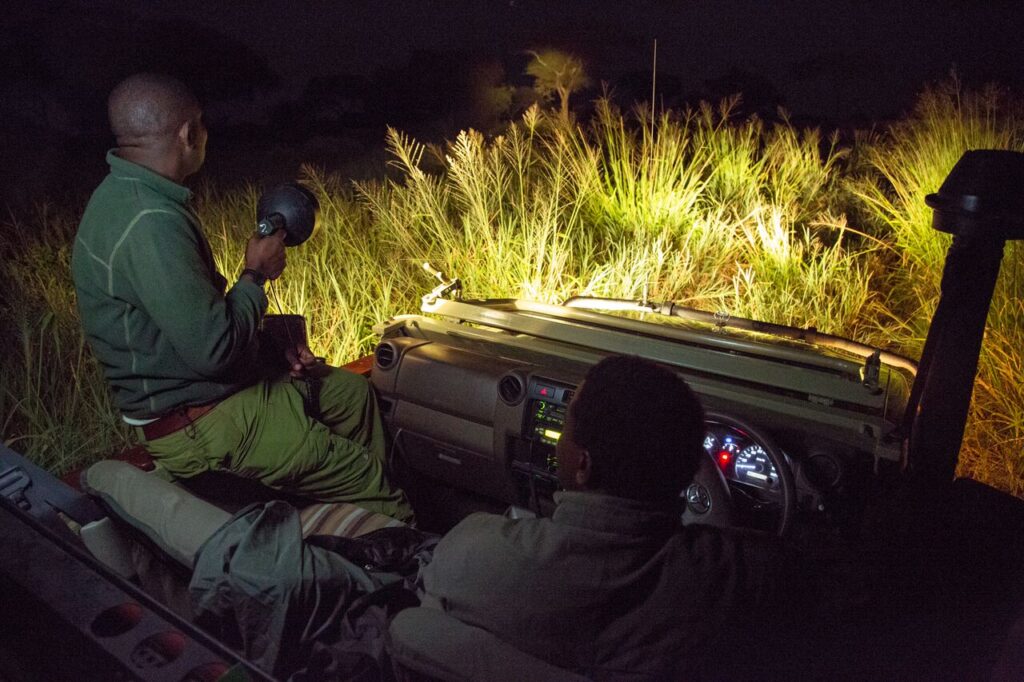
Night Game Drives in Uganda: What to Expect
Night game drives in Uganda open up a version of the savannah that daytime visitors never see. The heat that keeps lions dozing under acacia shade from noon until four fades after dark, and a different set of animals gets to work — leopards on the move, hyenas leaving their dens, genets hunting along the tree line.
It’s a genuinely different experience from a standard game drive, not simply the same activity with a torch attached. This guide covers where in Uganda you can actually book one, what it costs on top of your park fees, what you’re likely to see, and the practical preparation that makes the difference between an excellent evening and a cold, disappointing one.
Where You Can Actually Do Night Game Drives in Uganda
Night Game Drives in Uganda: What to Expect
Of Uganda’s ten national parks, the Uganda Wildlife Authority (UWA) permits night game drives in only three: Murchison Falls, Queen Elizabeth, and Lake Mburo. Each runs the activity on a restricted network of roads, with an armed UWA ranger guide required in the vehicle at all times.
Murchison Falls conducts its night drives on the north bank road system, the same open savannah where daytime sightings are already strong. Queen Elizabeth restricts the activity to pre-registered vehicles only, a rule UWA enforces to control how many cars are moving through the park after dark. Lake Mburo, Uganda’s most compact park at roughly 260 square kilometres, is a favourite for a first night drive simply because the wildlife sits closer together and sightings come faster.
The honest limitation: if your itinerary is built around Bwindi, Kibale or Kidepo Valley, a night game drive isn’t on the table at all. Anyone who wants this experience needs to route their trip through one of the three eligible parks.
What a Night Game Drive in Uganda Actually Costs
UWA prices night game drives separately from your park entry fee and your daytime game drive fee. Using a private tour vehicle, the standard rate is $30 per person, rising to $40 per person if you book through a UWA-operated vehicle instead. East African citizens pay UGX 50,000 for a private vehicle and UGX 40,000 for a UWA vehicle.
This fee is genuinely separate from everything else on your itinerary that day. A traveller doing a dawn game drive, an afternoon boat cruise and a night drive in the same 24 hours in Murchison Falls pays for all three activities individually, even though a single park entry fee covers the period. Ask your operator to itemise this before you book, rather than discovering it as a surprise line at the gate.
What Night Game Drives in Uganda Show You That Daylight Hides
The spotlight sweeps low across dry grass, and two green points flare and vanish — a genet, gone before the beam settles. Murchison Falls is the strongest park in Uganda for leopard sightings after dark; the cats that stay hidden through the heat of the day become genuinely active in the first hour after sunset, moving along the tree lines the daytime vehicles never linger near.
Lions shift from resting to hunting between roughly 7pm and 11pm, which puts a night drive squarely inside their most active window. Spotted hyena, rarely seen at all on a daytime circuit, emerge from their dens to forage across open ground. Civets, bush babies and nightjars round out a checklist that has almost no overlap with what a morning drive delivers.
None of this comes with guarantees. A night drive is still wildlife viewing, not a wildlife show, and a quiet evening with only eyeshine and rustling grass to show for it is a real possibility. Travellers who’ve already had a strong daytime drive and want the nocturnal layer on top tend to get the most out of it.
How a Night Game Drive in Uganda Actually Runs
Murchison Falls departures run from around 6.30pm to 9.30pm, a three-hour window timed to the first hours of full darkness. Vehicles stay on designated roads only — off-road driving isn’t permitted after dark in any of the three parks — and the accompanying UWA ranger controls the spotlight, typically using a red or amber filter that disturbs the animals far less than a plain white beam.
Queen Elizabeth’s pre-registration rule means you can’t simply turn up at the gate and ask to join a night drive; it needs booking in advance through your operator or lodge. Lake Mburo, by contrast, runs more informally and combines well with a late-afternoon boat trip on the lake beforehand, since the park sits close enough to Kampala for a shorter overall itinerary.
Preparing for the Cold and the Dark
Temperatures on Uganda’s savannah drop sharply once the sun goes down, and an open-sided safari vehicle offers no real shelter from the evening chill. Pack a fleece or light jacket and long trousers even if the afternoon was warm enough for shorts; the north bank of Murchison Falls, in particular, gets noticeably cold after 8pm.
UWA asks visitors to wear muted colours — greys, khakis, dark greens — rather than anything bright or reflective, since a spotlight catches pale or white clothing far more than it does the surrounding bush. There’s no formal minimum age for the activity, but a young child who can’t stay quiet for three hours in the dark will likely have a harder evening than the animals give them credit for; UWA generally suggests leaving very young children at the lodge instead.
Deciding If Night Game Drives in Uganda Belong in Your Itinerary
A night drive earns its place for travellers who have time for an extra activity, who’ve already banked solid daytime sightings, and who want the leopard-and-hyena layer that daylight simply doesn’t offer. It’s a poor fit for a tight itinerary with only one evening in a park, where the added cost and the chance of a quiet night compete directly with rest before an early gorilla trek or dawn game drive the next morning.
If Murchison Falls, Queen Elizabeth or Lake Mburo already sits on your route, it’s worth asking your operator to slot one in rather than treating it as an afterthought. At Terenga Safaris, we build night drives into an itinerary only where the timing genuinely works, so it adds to the trip rather than crowding it.