
White water rafting in Jinja, Uganda
July 6, 2026
Why Group Safaris Are the Smart Choice for Combined Safaris
July 7, 2026
Masai Mara vs Serengeti – Which Park Should You Choose?
Great migration
There’s a question I get asked more than almost any other, usually somewhere between the second and third gin and tonic of a planning call: Masai Mara or Serengeti? It sounds like it should have a simple answer. It doesn’t. What it has instead is a set of trade-offs that depend entirely on when you’re travelling, what you want to feel out there, and how much you’re willing to pay for it.
Both parks sit inside the same living system. The Mara and the Serengeti are not rivals so much as two rooms in the same house, joined by an unfenced border that the wildlife has never once respected. Understanding that relationship is the first step to making a good decision, so let’s start there before we get into the practical detail.
One Ecosystem, Two Very Different Experiences
The Serengeti–Mara ecosystem is a single, continuous stretch of savannah straddling Tanzania and Kenya, and the animals move across the international boundary as though it doesn’t exist — which, to them, it doesn’t. What changes is the scenery, the crowd density, the cost, and, depending on the month, which side of the border actually has the wildlife on it.
Size is the first thing that separates them. The Serengeti is roughly ten times larger than the Masai Mara, and that difference in scale shapes everything else about how each park feels on the ground. Fly into the Serengeti and you sense the space immediately — flat golden plains folding into rocky outcrops called kopjes, then into wooded river corridors, then into hills near the Kenyan frontier that start to resemble the Mara itself. The Masai Mara, by contrast, is compact and concentrated. You can drive across much of it in a morning, which sounds like a limitation until you realise it means wildlife sightings tend to be closer together and easier to string into a single game drive.
If the Serengeti is a novel with several distinct chapters — the short-grass plains of the south, the kopje country of Seronera, the river forests of the Western Corridor, the hillier north near Kogatende — the Mara reads more like a short story. Tightly plotted, fast-paced, and over almost before you’re ready for it to end.
Why the Great Migration Complicates the Choice
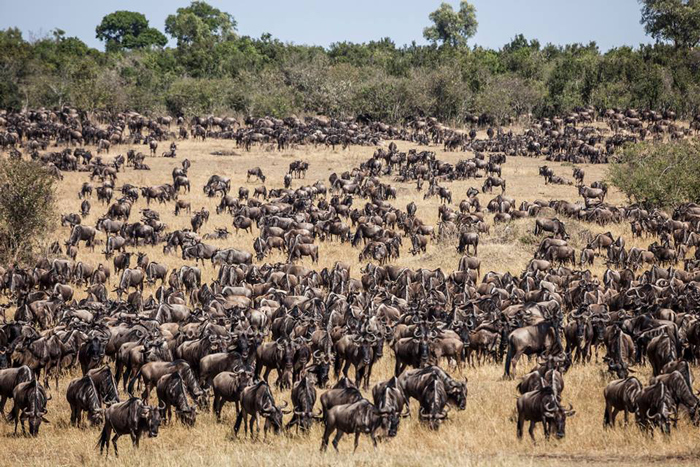
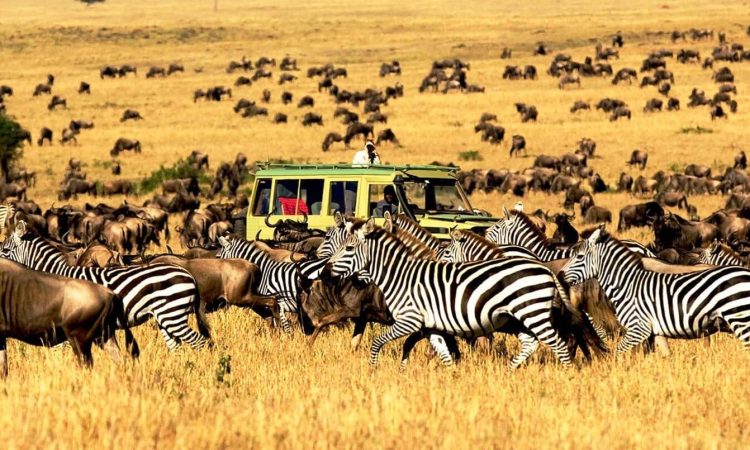
Ask most people why they’re weighing up the Masai Mara against the Serengeti and the answer, nine times out of ten, is the wildebeest migration. Fair enough — it’s genuinely one of the most extraordinary wildlife spectacles left on the planet, involving well over a million wildebeest alongside hundreds of thousands of zebra and gazelle moving in a vast, weather-driven loop through both countries.
Here’s the detail that changes how most people should plan: the herds spend roughly nine to ten months of the year in the Serengeti and only two to three months in the Masai Mara. That single fact does more to answer the Masai Mara versus Serengeti question than almost anything else in this article. If your travel dates are flexible and your priority is watching the migration story unfold — calving, predator drama, the long march north — the Serengeti gives you a far wider window to work with.
The famous river crossings, the ones with wildebeest launching themselves off muddy banks into water full of waiting crocodiles, generally happen between July and October, with the highest probability of drama in August and September. Crucially, those crossings can occur on either side of the border — the Mara River and the Sand River both cut through the Serengeti’s northern reaches before the herds cross fully into Kenya, so travellers sometimes assume the crossings are a Masai Mara exclusive when they’re really a shared, if unpredictable, event.
If you’re travelling between January and March, the calculation flips entirely in the Serengeti’s favour. This is calving season on the southern plains near Ndutu, when hundreds of thousands of calves are born within a few short weeks, drawing in lion, hyena and cheetah for some of the most intense predator activity you’ll see anywhere in Africa. During these months the Masai Mara is comparatively quiet — pleasant, resident wildlife still present, but without the migration’s theatre.
Masai Mara: Compact, Dramatic, and Built for Short Trips
The Masai Mara earns its reputation honestly. Its smaller size concentrates wildlife into a tighter area, which means guides can move between sightings quickly and a well-timed morning drive can deliver lion, elephant, and a river crossing in a single outing — something the Serengeti’s scale rarely allows. For travellers with five or six days rather than two weeks, that density matters enormously.
The Mara also carries one of the highest concentrations of big cats anywhere in East Africa, a legacy of decades of conservation work and the sheer richness of prey moving through during migration season. Photographers in particular gravitate here for the golden, low-angled light that rolls across the plains in early morning and late afternoon.
None of that comes without honest caveats. Because the reserve is small and its migration season overlaps with peak booking demand, July through October brings real crowding — vehicle numbers at popular crossing points can run into the dozens, occasionally more, and the atmosphere at a crossing site can feel closer to a sporting event than a wilderness encounter. Entry fees have also climbed; expect around $200 per person per day during peak season, valid strictly from six in the morning to six in the evening, non-transferable to the next day. For travellers wanting a quieter, more exclusive version of the same landscape, the private conservancies bordering the reserve — Naboisho, Mara North, Olare Motorogi among them — offer lower vehicle density and night drives, at a higher nightly rate.
Getting there is straightforward from Nairobi: a short scheduled flight lands you on one of several Mara airstrips within the hour, making it genuinely feasible as a long weekend addition to a Kenya itinerary.
Serengeti: Vastness, Variety, and Room to Breathe
If the Masai Mara suits travellers on a tighter schedule, the Serengeti rewards those willing to give it more time. Its name comes from the Maasai word Siringet, meaning the place where the land runs on forever, and that sense of endless horizon is not marketing language — it’s simply what the landscape does to you once you’re out on the southern plains with nothing but grass and sky in every direction.
That scale supports genuine ecological variety within a single park. The southern plains host the calving season and some of the most reliable predator sightings in Africa. Central Serengeti, around Seronera, is dotted with granite kopjes that serve as natural vantage points for resting lions and hunting leopards. The Western Corridor follows the Grumeti River through dense riverine forest, home to some of the largest crocodiles on the continent. And the north, near Kogatende and the Lamai Wedge, is where the terrain grows hillier and greener, foreshadowing the Mara just across the border.
Because the migration spends most of the year somewhere within Serengeti’s boundaries, a longer stay here — eight to ten days, ideally moving between two or three camps — lets you follow the story rather than catching a single scene of it. It also spreads visitor traffic across a much larger area, so even during high season the sense of crowding rarely matches what you’ll find at a Mara river crossing.
The trade-off is logistics and cost. Distances between regions are considerable, and covering the Serengeti properly usually means either long game drives or several short bush flights between camps, both of which add to the overall budget. Entry fees and Tanzania’s broader park and conservation costs are not insignificant either, and travellers should budget for a visa in addition to Kenya’s electronic travel authorisation if a Mara extension is part of the same trip.
Weighing Cost, Time, and Travel Style
Cost comparisons between the Masai Mara and Serengeti rarely favour one decisively over the other once you account for the full itinerary — flights, park fees, conservancy premiums, and the number of nights required to see either park properly. What differs is where the money goes. In the Mara, you’re often paying for proximity and density over a short stay. In the Serengeti, you’re paying for distance and variety over a longer one.
Family travellers and first-timers with limited time tend to do well in the Mara, where the shorter distances mean less time in a vehicle and more time actually watching wildlife, and where a five or six-day trip can still feel complete. Serious photographers, repeat safari travellers, and anyone hoping to understand the migration as an unfolding story rather than a single dramatic scene tend to lean towards the Serengeti, ideally paired with the Ngorongoro Crater nearby.
Neither park suits every traveller equally, and that’s worth saying plainly. Families with young children or those uncomfortable with long transfer times may find the Serengeti’s distances tiring. Travellers who dislike crowds should think carefully about visiting the Mara during peak crossing season, or should budget for a conservancy stay instead of the main reserve.
Making the Decision That’s Right for You
By now the honest answer to Masai Mara versus Serengeti should be taking shape, and it isn’t really about which park is better. It’s about matching the park to the month you can travel, the pace you want, and what you’re hoping to feel once you’re standing in the vehicle with the engine off and the plains stretching out in front of you.
If your travel window falls between July and October and you have five to seven days, the Masai Mara delivers concentrated, high-probability drama with minimal transfer time. If you can travel between January and March, or if you have ten days or more to spend following the migration’s full arc, the Serengeti offers a depth and variety that a shorter Mara trip simply can’t match.
At Terenga Safaris, we spend a fair amount of time on exactly this conversation with clients, because getting the timing and the park selection right does more for a safari’s success than almost any other single decision. Whichever side of the border ends up calling to you, the Serengeti-Mara ecosystem remains one of the last places on earth where a single unbroken landscape still moves to the rhythm of the rains rather than a human calendar — and that, more than any single crossing or checklist sighting, is the real reason to go.