Where to see lions in Uganda
July 27, 2026
Community Tourism in Uganda
July 27, 2026
How Tourism Benefits Local Communities in Uganda.
Community tourism in Uganda isn’t a marketing phrase tacked onto a brochure. It’s a set of specific, traceable mechanisms. A fixed share of park fees. A porter’s daily wage. A women’s cooperative selling baskets at a lodge gate. Follow the money from a single gorilla permit and it runs through district accounts, parish committees, and individual households near Bwindi, Kibale, and Murchison Falls. Some of that money arrives on schedule and does real good. Some of it gets stuck, or spreads thin, or never reaches the people the policy was written for.
This guide traces where tourist spending actually goes once it leaves your hands. It covers what the numbers show, and where the system still falls short. It’s written for anyone who wants a straight answer to a fair question. Does visiting Uganda genuinely help the people who live alongside its wildlife? Or is that just a good story?
How Revenue Sharing Funds Community Tourism in Uganda
Uganda’s national parks operate under a legal requirement, not a goodwill gesture. The Uganda Wildlife Act requires the Uganda Wildlife Authority to return 20% of park entry fees to the parishes bordering each park. The money arrives as conditional grants for schools, clinics, water projects, and measures that reduce conflict between people and wildlife. At Bwindi Impenetrable National Park specifically, an additional $10 from every gorilla trekking permit goes into the same pool.
The scale is real, if uneven year to year. In one recent disbursement, Bwindi’s surrounding districts received over UGX 2 billion. Mgahinga’s neighbours in Kisoro received just over UGX 111 million. Cumulative gorilla-linked payments to the five districts around Bwindi and Mgahinga have passed USD 10 million since the scheme resumed in the early 2000s. Money has funded a maternity ward extension in Buliisa and dozens of school-related projects. It has also funded livestock schemes that give households an income that doesn’t depend on crops wild animals might raid.
The process is slower and messier than the policy summary suggests. Funds pass from UWA to district governments, then to sub-counties, then to parish committees. Each layer retains 5% for administration costs. Disbursements have arrived years late in some districts. Kisoro’s own council leaders have publicly called the payments too small to offset the crop damage and restricted access that come with living next to a park boundary. Revenue sharing works as intended in many parishes. It hasn’t closed the gap between conservation costs and conservation benefits everywhere it operates.
The Jobs Behind Uganda’s Community Tourism
Beyond the formal revenue-sharing scheme, tourism creates jobs that never touch a government ledger. Porters hired for gorilla trekking earn a daily wage carrying packs and steadying visitors on steep, muddy trails. Most are recruited from villages bordering Bwindi and Mgahinga. Guides and trackers lead the treks themselves, and many are trained locally in conservation and first aid. Researchers studying Bwindi have estimated that for every ten tourists who go gorilla trekking, roughly fifteen community members earn something from the visit. That includes porters, drivers, and women selling drinks along the trailhead.
Lodges add a second layer of employment, and it tends to be more stable than trekking-day wages. Housekeeping, kitchen, grounds, and management roles at safari lodges across Uganda draw heavily on nearby villages. Several operators report local staffing well above half their workforce. This pattern matters because lodge jobs run year-round. Trekking income, by contrast, rises and falls with visitor numbers through the seasons.
None of this employment is guaranteed or evenly spread. Skilled roles such as head guide or lodge manager still favour people with training and connections. Not every village has equal access to either. The seasonal dip in visitor numbers during Uganda’s wetter months hits porters and casual staff hardest. A traveller who hires a local porter, and stays at a lodge with a strong local-hiring record, is backing the part of the system that works most reliably.
Women’s Cooperatives: A Grassroots Side of Community Tourism in Uganda
Women’s cooperatives represent a different kind of community tourism in Uganda. This model runs on craft and hospitality rather than trekking logistics. Ride 4 a Woman, based in Buhoma at Bwindi’s northern edge, began as a bicycle-rental scheme. It has grown into a centre training roughly 300 women from 11 surrounding villages in weaving, sewing, and cooking. A linked microfinance programme has helped more than 100 women start small businesses.
Visitors can spend an afternoon there weaving a basket or learning a Bakiga recipe. The fees and craft sales go directly to the women running the sessions, not through a government disbursement chain. Similar cooperatives operate near Kibale and Queen Elizabeth. They sell baskets, jewellery, and carvings straight to visitors passing through on safari.
This model sidesteps the delays that slow formal revenue sharing, since money changes hands on the spot. It also depends entirely on footfall. A cooperative near a busy gorilla-trekking trailhead does well. One further from the main tourist routes struggles to reach buyers at all. That’s why so many of these groups cluster around Bwindi rather than spreading evenly across the country.
The Batwa and Cultural Tourism: Uganda’s Most Complicated Community Tourism
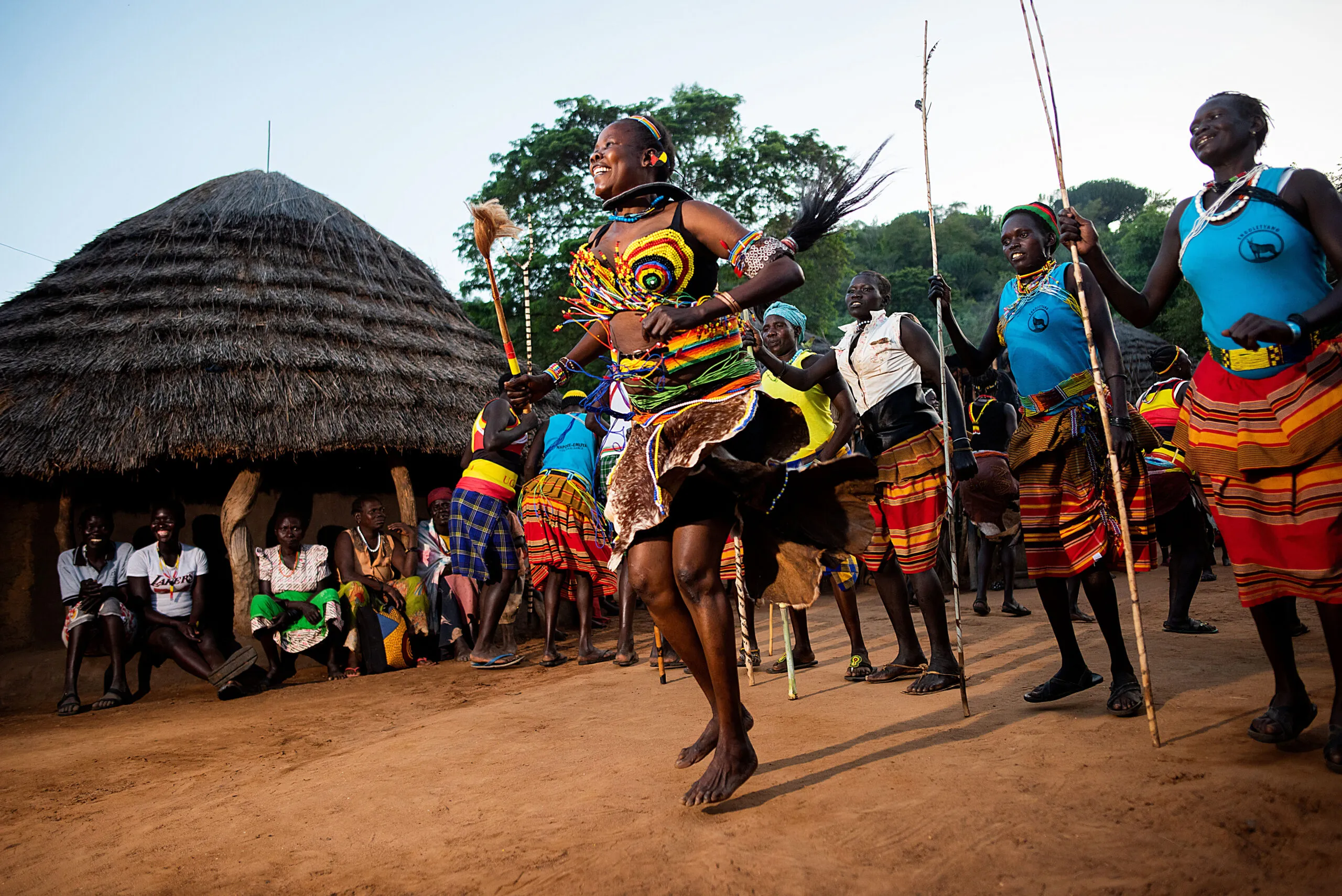
What Cultural Experiences Are Available in Kidepo
Cultural tourism around Bwindi also includes visits with Batwa communities, and this history carries more weight than a typical craft stall. The Batwa lived in the forest that became Bwindi Impenetrable National Park. Its gazetting in 1991 displaced them, without the land or compensation that would have let most families rebuild their previous way of life. The Batwa Trail and similar guided experiences now let visitors walk the forest with Batwa guides. They hear directly how the Batwa once foraged, hunted, and built shelters there.
For participating families, these visits provide income that revenue-sharing grants and casual trekking wages rarely reach. Batwa communities were displaced from park land, and in many areas they sit outside the parish boundary-sharing formula. Researchers studying tourism benefits at Bwindi have also found that access to this income stays uneven within Batwa communities themselves. It concentrates among those connected to a small number of established cultural tourism sites, rather than spreading across the wider population.
A traveller weighing whether to book a Batwa experience is really asking a broader question. Does my visit fund people directly, or does it pass through intermediaries who keep the larger share? For the Batwa Trail specifically, tour operators generally confirm that guide fees go to Batwa guides and community associations, not to the park authority. That’s worth asking about directly before booking, rather than assuming.
Where Community Tourism in Uganda Falls Short
The honest limitations of community tourism in Uganda go beyond any single programme. A widely cited academic study of gorilla tourism revenue at Bwindi found that over 75% of tourist spending leaks out of the local area entirely. It leaves through imported goods, foreign-owned tour operators, and costs paid outside the district. The same study found something else worth knowing: the revenue Bwindi’s communities do retain still exceeds every other source of income to the area combined. Leakage is real. Local retention still matters enormously in a place with few other income sources.
Corruption and mismanagement compound the delays. Conservation officials and researchers have both pointed to procurement problems and fund misappropriation as recurring issues within the revenue-sharing chain, on top of the structural leakage. None of this means community tourism in Uganda doesn’t work. It means the benefit a traveller’s money delivers depends heavily on which operator, lodge, and activity they choose. Visiting a park with a revenue-sharing scheme isn’t enough on its own.
Choosing Operators That Get Community Tourism in Uganda Right
A traveller who wants their spending to reach people directly has more control over that than the revenue-sharing statistics suggest. Hiring a porter on every trek, even a short or easy one, puts money straight into a household rather than into an administrative pipeline. Choosing lodges that publish their local-staffing figures, rather than simply claiming a vague commitment to sustainability, tends to correlate with jobs that actually go to nearby villages. Buying crafts directly from a cooperative, rather than from a curio shop in Kampala or Entebbe, keeps the full sale price with the people who made the item.
Terenga Safaris builds these choices into its Uganda itineraries as standard practice. Porter bookings go on every trek. Lodge partners are chosen for their record of local hiring. The difference between a safari that helps and one that merely visits comes down to exactly these decisions. Ask any operator, before you book, which fees go to communities directly and which fund the broader revenue-sharing system. Both matter, but they work in different ways. A good operator should explain the difference without hesitating.